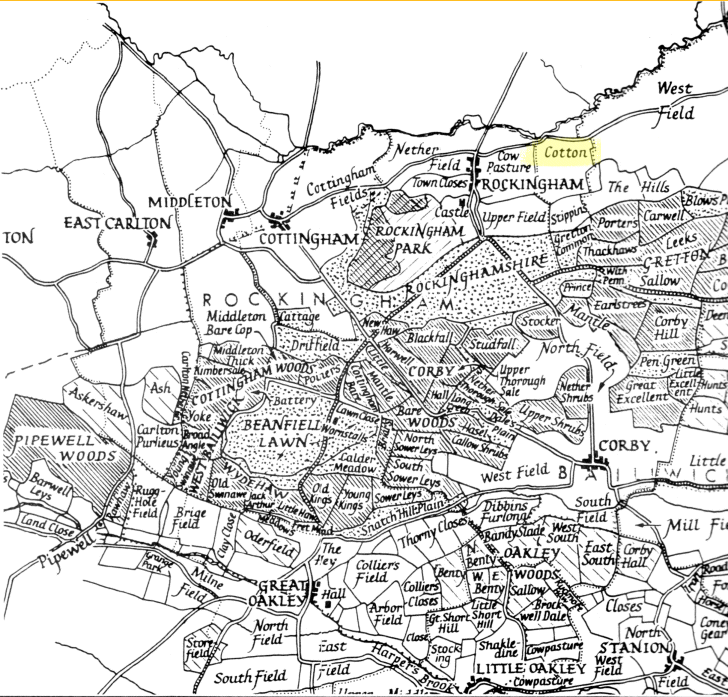
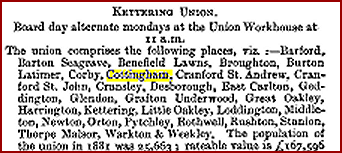
Up until the dissolution of the monasteries in 1543, the poor and sick were looked after by religious establishments. There was a hospitals for lepers dedicated to St Leonard located at a place called Cotes or Coton, which was on the right hand side of the Rockingham to Gretton Road, shown on the 17th Century map above. Some historical directories, including Kelly’s Directories, refer to this lepers’ hospital as being in Cottingham. However, in his book Rockingham Forest Revisited, Dr Peter Hill says that this is an error, and that Cottingham is a misreading of Coton.Today, there is a group of cottages called The Cottons in this area.
In 1601, the Poor Law came into being, making each parish responsible for the upkeep of its poor, including destitute single mothers, by means of a rate levied on the village that would be used, in many cases, to build poorhouses or almshouses. There were almshouses in Middleton, East Carlton and Rockingham.
In 1834, Poor Law Unions were set up representing several communities to build centralised workhouses. Cottingham was under the wing of the Kettering Union Workhouse, built in 1837 to accommodate 250 inmates (see extract from Kelly’s Directory). The building later became St Mary’s Hospital on London Road.
Well–off villagers sometimes recognised the poor in their wills:
- William Downhall‘s will (1760) left the rent of 18 acres to the poor of Cottingham and Middleton. In the 1870s, this land produced £30 which was chiefly distributed in fuel. There is a wooden board in the belfry end of St Mary Magdalene with the will of William Downhall.
- William Riddell left the rent of 1 acre, 1 rood and 39 perches for apprenticing poor children. By 1914, this amounted to £3 10s a year. William also left ‘small sums at interest for the benefit of the poor’.
- In her will (1835) Mary Aldwinckle left £10 to the church wardens to distribute amongst the poor on Christmas Day following her decease, and £40 to ‘place out four poor boys belonging to the parish of Cottingham as apprentices’ giving the church wardens discretion to choose the best trade for the boys’ advantage and future prospects.